Wednesday, March 14, 2018

3 Things In Biotech, March 13, 2018: Uncertainty Abounds!

Welcome to another edition of "3 Things In Biotech You Should Learn Today," a daily digest dedicated to helping you keep pace with the fast-moving world of pharmaceutical and biotechnology research.

Advaxis halts its phase 1/2 combo study.

Company: Advaxis, Inc. (NASDAQ:ADXS)
Therapy: Axalimogene filolisbac and durvalumab
Disease: Advanced, HPV-associated cancers
News: ADXS disclosed that its phase 1/2 study evaluating the combination of axalimogene filolisbac and the PD-L1 inhibitor durvalumab (branded Imfinzi) was placed on hold by the FDA after a trial site reported a grade 5 adverse event. The patient suffered respiratory failure shortly after receiving her latest round of therapy after over a year of treatment. No details of the adverse event in question were offered.
Looking forward: This seems like deja vu for ADXS, which had a ground-shaking hold a few years ago that impacted trial recruitment and ultimately came to naught. I don't think this is in the same league, though, because it's one program among many for the company, and it does not affect the development of axalimogene filolisbac. Given that this adverse event has not been reported yet in any context for ADXS, I would expect that the FDA will lift this hold sooner or later, with the caveat of providing monitoring for the adverse event in question.
Overall, the naysayers are calling for the Advaxis doom, but I'm not convinced on this news alone.

AstraZeneca guides a delay in its MYSTIC study

Company: AstraZeneca (NYSE:AZN)
Therapy: Durvalumab and tremelimumab
Disease: Advanced non-small cell lung cancer
News: AZN announced an update to its timeline on reporting of overall survival data from the phase 3 MYSTIC trial, which is assessing the combination of durvalumab and tremelimumab compared with chemotherapy as first-line therapy for advanced non-small cell lung cancer. The company now expects to report these findings in the second half of 2018 instead of the first half.
Looking forward: I'm not quite sure what to make of these developments, honestly. On one hand, a delay of any kind would be a bad look for a trial that already has a pedigree of failure (recall that MYSTIC failed to demonstrate a PFS benefit over chemotherapy). However, since the trial is event-driven, a longer-than-expected OS readout could possibly indicate favorable results. However, that is extremely speculative at this point.
Overall, this news isn't too groundshaking, but if you like to read the tea leaves... positive findings from MYSTIC would reap major rewards for AZN, for sure.

Anthera Pharmaceuticals kills a pivotal exocrine pancreatic insufficiency trial

Company: Anthera Pharmaceuticals (NASDAQ:ANTH)
Therapy: Sollpura
Disease: Exocrine pancreatic insufficiency due to cystic fibrosis
News: ANTH announced top line data from its phase 3 RESULT study, showing that this trial failed to reach its primary endpoint of non-inferiority compared with porcine pancreatic enzyme replacement therapy in terms of coefficient of fat absorption, with a proportion of patients having their condition worsen. The secondary endpoint, coefficient of nitrogen absorption, met the noninferiority goal. The company indicated that it would suspend further development of Sollpura.
Looking forward: This news proved catastrophic for ANTH, as it lost some 80% of its value on the day of this announcement, down to a sub-$10 million market cap. It would appear as though this could be a last breath for the company before succumbing to wounds inflicted by such a disastrous trial.
No way I would think about buying this company, as there is very little in the near term that could bring it out of the depths here.
Author's note: Thank you for taking some time out of your day to read some commentary on recent biotech happenings. I hope you'll consider leaving a comment or a question in the section below! This is one way in which Seeking Alpha is able to gauge the effectiveness of its writers and the platform. So if you want to keep seeing more editions of "3 Things," go ahead and participate!
As I mentioned above, I am now collaborating with Avisol Capital Partners on their Marketplace service known as the Total Pharma Tracker (TPT). Some of my work will be available to TPT subscribers, either exclusively or in advance. I will also collaborate in developing watchlists and other investment essentials. Please subscribe to TPT by clicking on this link - Total Pharma Tracker.
Disclosure: I/we have no positions in any stocks mentioned, and no plans to initiate any positions within the next 72 hours.

I wrote this article myself, and it expresses my own opinions. I am not receiving compensation for it (other than from Seeking Alpha). I have no business relationship with any company whose stock is mentioned in this article.

Costco Wholesale Corporation's Sales Growth Remains Impressive

Investors didn't react well to Costco Wholesale's (NASDAQ:COST) second-quarter earnings report. Its shares dropped after the company's earnings per share (adjusted for tax effects) came in at $1.42, $0.05 lower than the average analyst estimate.
However, the comparison between Costco Wholesale's adjusted EPS and the analysts' estimates may have been skewed by the implementation of the U.S. tax reform bill during the quarter. (CFO Richard Galanti hinted at this possibility in the recent earnings call.) Moreover, Costco continues to post remarkably strong sales growth, and its profitability is very stable. This bodes well for its future earnings.

Robust sales growth continues

Costco's sales growth has accelerated dramatically in the past year, following a slowdown in late 2016 and early 2017. During the first half of fiscal 2018 -- i.e., the 26-week period that ended on March 4 -- comp sales surged 9.4% year over year. New warehouse openings pushed Costco's sales growth well into double-digit territory.
Excluding exchange rate fluctuations and gasoline price inflation, Costco still would have posted a strong 6.6% comp sales increase for the first 26 weeks of the fiscal year.
The exterior of a Costco Wholesale warehouse during the day
COSTCO'S ROBUST SALES GROWTH TRENDS CONTINUED LAST QUARTER. IMAGE SOURCE: COSTCO WHOLESALE.
As part of its second-quarter earnings release, Costco also reported its February sales results. The company's sales growth actually accelerated relative to the year-to-date pace, with comp sales up 10.5%, or 7.7% excluding gasoline price and foreign currency fluctuations. The bulk of this acceleration came outside the U.S. and Canada. The timing of the Lunar New Year boosted sales in Asia last month, but Costco also saw strong sales growth in Mexico.
The recent closure of dozens of Sam's Club warehouses may have boosted Costco's February sales. The sales gains could continue to build over the remainder of 2018 as more Sam's Club members switch their allegiance to Costco.

EPS misses expectations: So what?

As would be expected, Costco's strong sales growth last quarter allowed it to reduce its operating expenses as a percentage of revenue. Gross margin also improved modestly year over year, excluding the impact of gasoline price inflation. Additionally, Costco continues to benefit from outsized membership fee growth, after raising prices in the U.S. and Canada last June.
The net result was that operating income surged 20% year over year in the second quarter. That's nothing to sneeze at, even if adjusted EPS did fall short of expectations.
Furthermore, of the $74 million in tax benefits that Costco highlighted, only $22 million relates to one-time effects of the new tax law. The rest reflects ongoing savings that Costco will capture from a lower federal corporate tax rate. Excluding only the $22 million nonrecurring tax benefit, Costco's adjusted EPS would have been $1.54, $0.07 ahead of the average analyst estimate.
Looking ahead, Costco Wholesale's tax savings will increase. In recent years, its effective tax rate has averaged 34%-35%, excluding one-time tax benefits in years that it has paid a special dividend. Going forward, management expects the effective tax rate to average about 28%. This would provide a long-term EPS boost of approximately 10%.

The fundamentals are solid for long-term investors

As long as Costco Wholesale can continue growing comp sales at a mid-high single-digit rate -- which could be a long time, given the company's widening cost advantage over rivals -- it should be able to grow earnings even faster than that.
For example, whereas many retailers are getting squeezed by a tighter labor market and rising wage levels, Costco already raised its starting wage to a minimum of $13 an hour two years ago. Within four years of joining the company, most workers are paid roughly $22.50 an hour. As a result, Costco should have no trouble retaining its employees.
Additionally, while the company will use some of its tax savings to boost wages, it still won't face the same level of wage pressure as most rivals. Indeed, Costco could be a net beneficiary of a tighter labor market, if higher paychecks lead to increased consumer spending.
In short, the retail giant's moat is alive and well. This is a recipe for solid long-term stock performance, notwithstanding Costco Wholesale's relatively high valuation.

Gold 'loves any turbulence' as metal rises following Tillerson's exit

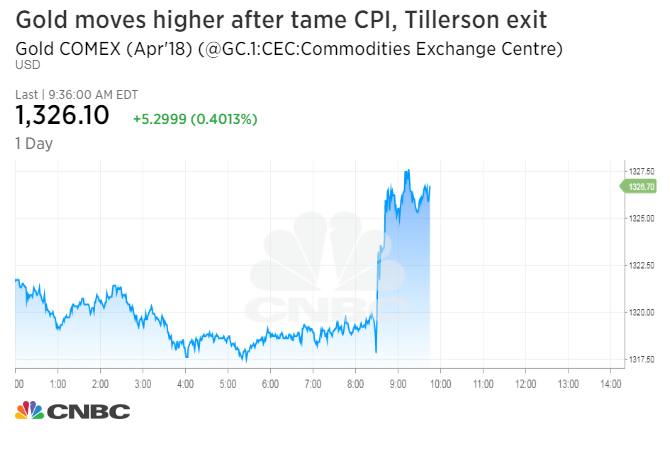
Gold was bid higher after Secretary of StateRex Tillerson became the latest high-profile casualty of the Trump administration.
Tillerson, former ExxonMobil CEO, was respected in the markets and was seen as a steady hand but was previously reported as being ready to exit his role. President Donald Trump immediately replaced him with CIA Director Mike Pompeo. Deputy CIA Director Gina Haspel was named CIA director.
Gold futures for April were trading at $1,327, up about a half percent.
"Gold loves any turbulence, any uncertainty," said Kevin Grady, president of Phoenix Futures and Options.
Grady said gold was bid higher after the 8:30 a.m. ET release of CPI showed tame inflation, exactly in line with economists' consensus estimate of a 0.2 percent gain. The low reading on inflation is not likely to spur faster Fed rate hikes, and that also brought in buyers.
The Tillerson exit was also a plus for gold. "The news gives you support but I wouldn't say, 'I need to be long gold. Gold is going to explode because Tillerson is out,'" said Grady. "It's more uncertainty for the market. More uncertainty in general. I think a lot of these things keep a bid in gold."
Gold has tried unsuccessfully to break out. "The 100-day moving average is right around $1,307, and the 200-day is right around $1,297, so we've been holding right around these lows, and the market keeps selling off," he said. "But it's holding these levels because I think there's so much uncertainty in the market."
Grady said Tillerson's exit was viewed as a negative, but the fact that Trump has said he would talk to North Korea was seen as a positive development.